Tag Archives: Pounds

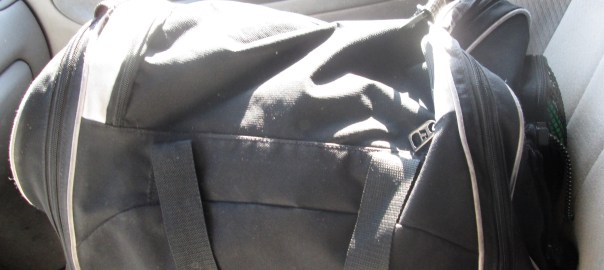
Take Your Gym Bag With You

It can be difficult at times to stay dedicated to your workout plan. There are many things that can get in the way. However, here is one thing you can do in order to make your commitment to your workout a little easier–take your gym bag with you.

Now, I understand that many people who are dedicated to working out do so at home or in the morning. This will not apply to you.

However, if you are one of those people who go to the gym after work, this will help. Why? You can imagine why for yourself. You leave work with every intention of going home, changing, and going to the gym. But when you get home personal business gets in the way. The phone rings, you need to pick up something for dinner…. The list could go on. Or you get home and you want to sit down for just a second and once you do you realize that you are too tired to make it to the gym.

Has this happened to you? My post-work workout has been derailed more than I’d like to admit because of things like this. The way to avoid this is by simply bringing your gym bag with you. You will avoid going home and getting tangled up in everyday life.

Of course I’m not saying that bringing you gym bag with you will magically solve all the obstacles that could get in the way of your post-work gym session, but it is one easy thing you can do in order to stack the deck in your favor. So, if you are going to go to the gym after work, take your gym bag with you!

Intermittent Fasting Wars PT. 4

This is the final installment in this short series of articles on intermittent fasting (IF). In this article, I will explain what IF protocol I used and why. Also, I will give you some tips on choosing an intermittent fasting protocol for yourself.

Which IF I Used

I chose the Warrior Diet because it was, in my opinion, the easiest to follow.  Why? First off it is a daily plan. I did not have to remember whether this was a day I was eating or not. I just did the same thing every day.

Also, on the Warrior Diet I got to eat every day which made it easier to stick to my low-carb lifestyle. This did not always happen as I will explain later, but being able to eat every day made low-carb a more viable option. On the other hand, when I experimented with alternate day fasting and Eat Stop Eat one of the biggest problems I had with these diets is that after 24 hours of fasting, I wanted to eat everything in sight. On these diets you are allowed to eat normally which I have described in previous posts. But after a 24 hour fast I wanted to eat like it was Thanksgiving.

Like I said above, I did not always eat low-carb when I was on the Warrior Diet. And the truth is that you do not have to. But I did eat low-carb most of the time. However, the ability to eat whatever I wanted during my eating window allowed me to be more flexible while eating with my friends and family.

Which IF Plan Should You Do? 

First off, do not be afraid to experiment.  And do not be afraid to switch to another plan if one is not working out. But you must be able to chose a plan that you will stick to and that will fit into your life. If you live alone and do not mind skipping a day of eating, you might do better on alternate day fasting or Eat Stop Eat. If you have a family and you eat with them every night, you might do better on the Warrior Diet. Just remember the best plan is the one you will actually do.

Final Observation

One more thing I noticed about IF that I wanted to mention has to do with the fact that a lot of these plans allow you to have carbs during your eating window. However, what I noticed is that the the longer your eating window is the more low-carb you need to go in order to see results. For example, if you are going to break your fast between 14-18 hours and give yourself a longer eating window, you need to really be cautious of the carbs you are eating. Basically you need to stick to a low-carb diet. On the other hand if you fast for 20 plus hours you have a greater tolerance for carbs. This means that if you only eat for say two hours, you can eat more carbs and still lose weight.

Why Low Carb Is Not Enough (Audio)

In this episode, Ian Carlin talks about why low carb dieting is a great place to start but it will most likely will not get you to optimal health. Also, what you need to know about switching gyms. Enjoy!

What You Need To Try Before You Give Up (Audio)

A new episode of A Mind For Fitness Podcast is now available. In this episode Ean Carlin talks about why we want to give up on trying to lose weight and what you need to know before you do! Enjoy!

The Intermittent Fasting Wars Pt. 2 (Written)

If you really want to lose weight, you need to eat 6 small meals a day. And you never want to skip breakfast! Right? Well, that is what I was told my whole life. In fact, fairly recently I did a review (audio) on Chris Powell’s book, Choose to Lose: The Seven Day Carb Cycle Solution. In that book, he advocates six small meals a day. I followed it for a while and I lost weight!

Well the truth is I lost a little weight. And the reason I lost it was not because the diet was so great. Rather it was due to the fact that I was on a plateau and it changed things up enough to get my metabolism working again.

The six meal a day plan can work for some of the people some of the time. For example, if you take someone who is eating a bowl of granola in the morning and/ or a bagel, and switch them to 4 egg whites and half a banana, you will see results. Out of the two, the former is way worse for your blood sugar. So the six meal a day diet can work, but it does not work nearly as well as intermittent fasting (IF).

Why IF Works 

There is lots of science regarding IF. I do not have the time to go into all of it here. However, I will quickly mention that the reason it works is that it allows your body to tap into your fat reserves. Your body only runs on two types of fuel–sugar and fat. When you eat 3 or 6 times a day you are fueling your body with sugar and training your body to prefer to run on sugar.

However, when you go without food for a significant period of time, you use up all your sugar. The only fuel left for your body to run on is fat. And in fact, your body runs better on fat than sugar. And the more often you run on fat, the more your body wants to run on fat preferentially.

There are lots of big words I could have used to explain the above paragraphs, but it really is that simple. If you do not have sugar in your body, you will run on fat.

Starvation Mode 

But what about starvation mode? If you have been led to believe that 3-6 meals is the way to go, and that you should never skip breakfast, you may have also heard of the dreaded “starvation mode.” This is the belief that if you do not keep feeding your body every 2 hours or so you will store fat instead of burn it. Why? Because (they say) your body thinks it is going though a famine and will want to hang onto fat.

The fact of the matter is that this is simply not true. In order for your body to go into “starvation mode,” you have to go without food for a few days. But even then, you will eventually start losing weight. So do not fear. Going without breakfast, or even going without food for a day, will not not make you gain weight!

IF Programs

There are many IF programs to choose from. In the next article, I will list them and let you know which protocol I chose to lose nearly 20 pounds in about a month!

True Confessions: How I Gained Weight Again (And How I lost It Audio)

A new A Mind For Fitness Podcast is now available. This is a good one. I come clean and talk about how I gained weight again but also how I lost it and am now more fit than ever. Enjoy!

Why We Hit Plateaus In Weight Loss

I recently did a podcast where I addressed the issue of hitting plateaus in weight loss. I talked about why we hit them and what we can do to get past them. This blog post will address the first half of the issue. Namely, why we hit them. In the next post, I will talk about what not to do and why. After that, I will talk about the active things you can do to get past them and get back on the road to burning fat.

Two Main Causes

The truth is there is only two reasons why your weight loss progress stops. The first is you are just not sticking to your diet correctly. The second is your body has simply adjusted to your dietary and/or workout regiment.

Not Sticking To Your Diet

Sometimes your not sticking to your diet simply because you are cheating too often. If this is the case, the truth is you need to do the diet correctly.

However, there are times when you really think you are sticking to your diet, but in reality you are unknowingly are consuming too many carbs and too many processed foods. For example that salad you had for lunch may have had many more carbs than you thought.

On one occasion I was happily eating a salad when I noticed that it was slightly sweeter than I thought it should be. The reason for this is that there were craisins in the salad. When I finally looked up the carb count in craisins, I realized that my salad contained my daily allotment of carbs. I was shocked.

If this kind of thing happens too often, you will certainly stop losing weight.

Body Adjustment 

However, for many, you are sticking to your diet and you have still hit a plateau. The reason for this is that your body has adjusted to your diet and/or workout plan. One thing to keep in mind is that your body is always looking to establish an equal balance within itself. Losing wight is an imbalance within the body. And an imbalance is a shock and perceived as a treat to survival. Even though there are great benefits to losing excess fat, your body is still seeking to establish equilibrium as a survival tool.

Next Post

So there are your two reasons why you will stop losing weight. The next post will deal with what not to do about it.

If you liked this, please share this post on your favorite social media.


Getting Past Your Plateau (Podcast)

A new episode of A Mind For Fitness Podcast is now available. In this episode, Ean talks about why we hit plateaus. And what we should and should not do about it. Enjoy!

5 Easy Ways to Lose Weight For the New Year (Audio)

A new episode of A Mind For Fitness Podcast is now available! In this episode, Ean talks about five ways to lose weight for the new year and the new you!

The Carb Cycling Wars

Not that long ago in our own galaxy, in fact, on our own planet, there was an obesity epidemic. In response to this epidemic, an evil empire of dietitions arose and ceased power. This evil empire insisted that a low-fat, calorie restrictive diet was the answer to this problem. However, they were wrong.

In response to the evil empire, there was a rag-tag group of rebels who fought against the dogma of the day. These people insisted that the answer  to obesity were low-carb, ketogenic, and Paleo diets.

Those who followed these diets had great success. But often they did not meet their ultimate weight-loss goals. The Rebels came to realize that cycling carbs was one of the solutions to this problem. What follows is a small portion of their story:

All Kidding Aside 

All kidding aside, the truth is there are health benefits for cycling carbs. That is to say it is beneficial at times to have more carbs. In fact, if you have hit a plateau in your weight-loss, this is a great way to re-ignite your fat burning hormones.

The fact of the matter is that there are a number of carb-cycling plans to choose from. These plans differ on the amount of days you should carb-cycle, as well as what kinds of carbs you should have.

What follows is a list of some of the major proponents of carb-cycling and the way the do it. However, this is not an exhaustive list. This is just a list that I am acquainted with.

Ethical Disclaimer 

I cannot share every detail of the methods listed below due to ethical reasons.  The authors I have researched draw their income from the books they sell. Therefore, I have tried my best to offer a fair evaluation of their method while not revealing everything they recommend. In other words, what is listed below is just an outline. To get a fuller understanding, you need to buy the books.

That said, some of these authors have publicly  shared much more about their diets than others. For those who have shared more openly, I have revealed more about their protocols.

Kiefer

Kiefer is the author of Carb Nite Solution and Carb Back-Loading. Both are carb-cycling diets. Here is what you need to know

Carb Nite Solution Essentials

This is an ultra low-carb diet for 6 days of the week. One day of the week, or more appropriately, one night of the week you can have as many carbs as you want. In fact you can have as many carbs as you want from any source that you want. This is to say that Kiefer allows for “dirty” carbs. You are not just carb-loading with sweet-potatoes and fruit, you can have cake and ice cream as well. No food is off limits.

However, it is important to note that you don’t have to have dirty carbs. You can do this protocol with clean carbs as well. He just does not restrict to clean carbs only.

Carb Back-Loading Essentials

This diet is very similar to Carb Nite. But it differs in that there is more than just one night a week you carb-load. On this diet, you can carb-load, in the evening or after noon, but only after an extremely heavy workout. You can also have dirty carbs on this diet too.

One important difference between these diets is the intention. Carb Nite is inteded for weight-loss, while Carb Back-Loading is intended for bulking.

Dave Asprey

Dave Asprey is the creator of the Bulletproof Diet. He also runs a company and has a podcast of the same name.

Bulletproof Carb-Cycling Essentials

This is basically a low-carb diet, but not an ultra low-carb diet. This diet focuses more on the quality of food you eat. It allows for some clean carbs at night in order to help sleep and other functions.

On this diet, Dave recommends that one day a week you carb-load. Also, on the day you carb-load, you are suppose to protean fast. Meaning you have very, very little protean. Dave very highly recommends carb-loading with only clean carbs. That is lots of white rice, certain fruits, and other clean sources of carbohydrates. That said, he does allow for the occasional (very occasional) dirty carbs. But it should not be the main source of your carb-loading and you need to be prepared to accept the consequences.

Chris Powell

Chris Powell is most famous for tuning fat people into fit people on his television show, Extreme Makeover: Weight Loss Edition. He has written a couple of books but I am only going to deal with one of them here, Choose To Loose: The 7 Day Carb Cycling Solution.

7 Day Carb Cyceling Solution Essentials

This method is the most liberal when it comes to carbs. Basically the diet is one day of high carbs and one day of low carbs. Sounds easy but things do get complicated. Even on the low-carb days, he recommends that you eat a carb portion at breakfast. Your meals are also split into five small meals throughout the day. All carbs during this cycle are clean.

However, one day a week, you can have anything you want. This includes dirty cabs. So it is high-carb, low-carb (except for breakfast)….. until Sunday. On Sunday, no food is off limits.

Jason Seab

Our final player is Jason Seab, aself proclaimed Paleo proponent. He is the newest contributor on the list with his book Alt Shift.

Alt Shift Essentials

The Alt Shift protocol recommends a few days on an extremely low-carb diet, followed by a few days on a high carb-diet. There are no dirty carbs on this diet.

Conclusion 

Which carb-cycling is right for you. The truth is, if you are already fat-adapted, and you have stalled out on your weight-loss, just about any one of these diets will help. But self experimentation is always the best way to find out. So give each of them a fair shot and see what works.